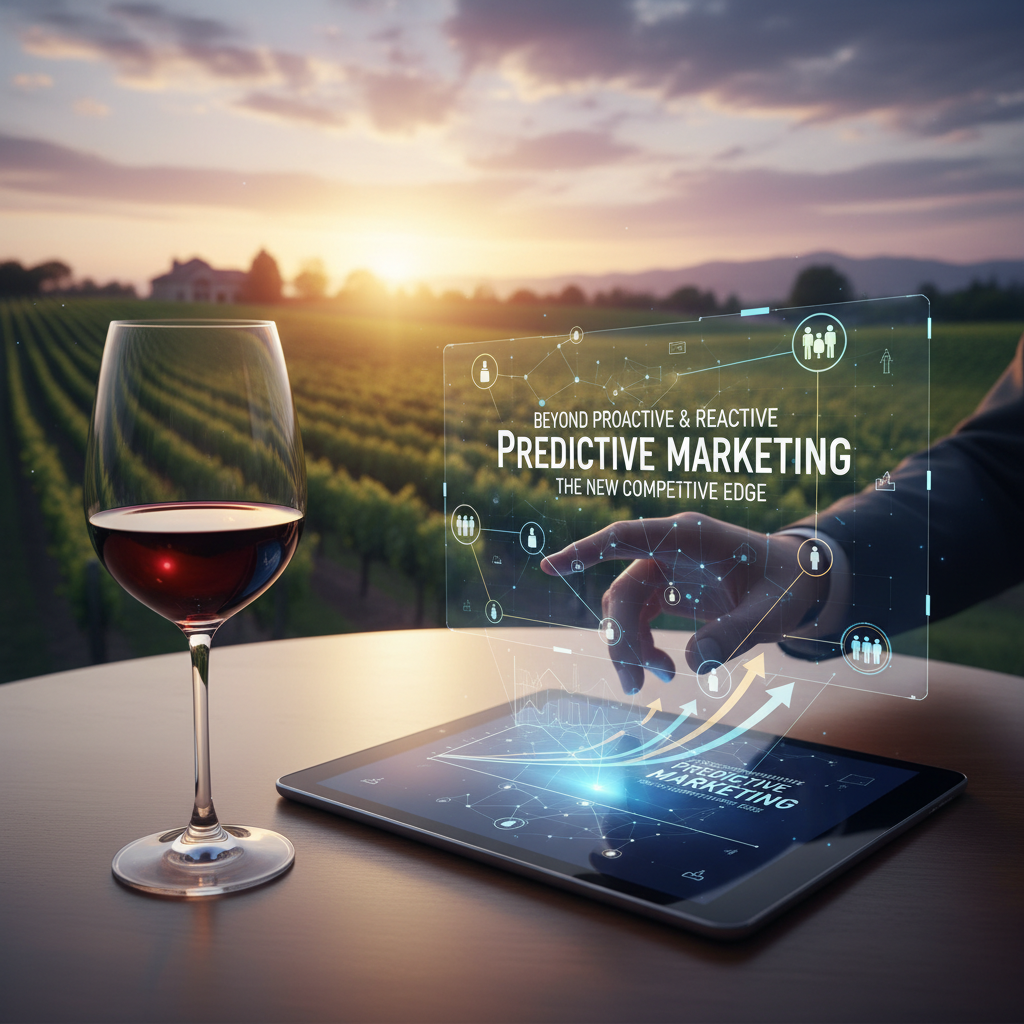
Beyond Proactive and Reactive: Why Predictive Marketing Is the New Competitive Edge for Wine Brands
The most successful wine brands in 2026 aren't just responding to trends or anticipating them, they're predicting them. Here's how to build that capability.
For years, the marketing conversation in the wine business (but other sectors too) has revolved around a simple spectrum: are you reactive or proactive? Reactive brands chase trends after they break. Proactive brands try to get ahead of them. But in today's data-saturated, algorithmically driven media environment, both postures are increasingly insufficient. The brands capturing market share in North America, in Japan, across the EU, are operating at a third level entirely: they are predictive.
Predictive marketing is more than a buzzword. It is a disciplined, data-informed operating model that allows a brand to anticipate consumer behaviour, media performance, and market shifts before they manifest. From there marketers then act with precision. For wine brands, where category purchase cycles are emotional, seasonal, and deeply influenced by cultural context, predictive capability is a strategic necessity.
What Predictive Actually Means
Predictive marketing sits at the intersection of three capabilities: historical performance data, real-time signal monitoring, and forward-looking modeling. This means using structured data including sales velocity by SKU, digital engagement patterns, search trend curves, distributor reorder rates, import licensing timelines, to build probabilistic models of what will happen next, and allocating media and messaging accordingly. This is the marketing science or what we call data-driven marketing.
In practical terms, a predictive wine brand does not have to wait for Q4 gifting season to activate holiday campaigns. It identifies, months in advance, which SKUs are trending upward in on-premise accounts in specific metro markets, cross-references that with social listening data showing emerging flavour conversations, and begins building media weight in those corridors before competitors have even scheduled their planning meetings.
The difference between proactive and predictive is timing and precision. Proactive is knowing winter is coming and stocking wool. Predictive is knowing which specific consumers will buy which specific weight of wool, in which city, at what price point, and in which week, then having your campaign live before they even know they [consumers] want it [the wool]. In wine terms this would mean: proactive is knowing summer is coming and stocking rose. Predictive is knowing which specific consumers will buy which style of rose, in which format and packaging, in which city, at what price point and from what type or retailer, and precisely which weeks so that the campaign goes live ahead of the game. This is what digital advertising and media outlets have been working on for a long time. Now data-driven marketing enables to leverage AI algorithms to precisely predict your next marketing move.
The Data Infrastructure Wine Brands Need
Harnessing predictive marketing requires wine brands to build or partner to access three foundational layers of intelligence.
First, category and channel data. In markets like Japan, where imported wine faces nuanced import duty structures and retail channel behaviour is highly segmented between convenience, specialty, and on-premise, understanding velocity by channel is non-negotiable. Brands exporting into Japan must model purchasing cycles around cultural gift-giving moments Ochugen, Oseibo with at least 90-day lead times on media activation. This is a step further than proactive planning; this is predictive scheduling tied to known behavioural windows.
Second, first-party consumer data. EU data privacy regulations under GDPR have fundamentally altered the landscape for digital targeting. Wine brands operating across European markets can no longer rely on third-party cookie pools for audience segmentation. Those who have invested in building direct consumer relationships such as through wine clubs, DTC e-commerce, sommelier programmes, and CRM capture at events, now hold a material competitive advantage. Their predictive models are fed by consented, high-quality data. Everyone else is flying increasingly blind.
Third, AI-assisted media planning. Modern media planning platforms, increasingly integrated with generative AI and machine learning, can now simulate campaign performance scenarios before a single euro or dollar is spent. For wine brands with constrained marketing budgets, which is most of them, this means allocating spend to the channels, formats, and timing windows most likely to drive measurable outcomes, rather than defaulting to legacy media habits.
A Case Study in Predictive Execution: Cloudy Bay
Cloudy Bay, the New Zealand Sauvignon Blanc benchmark owned by LVMH, offers one of the clearest examples of predictive brand management in the premium wine category. Rather than simply responding to the global natural wine conversation or reactively discounting to maintain volume during economic downturn and on-premise softness, Cloudy Bay leaned into forward-looking consumer segmentation.
The brand identified, through search trend modeling and sommelier network intelligence, that a specific cohort of urban, experience-oriented consumers in the UK and Australian markets were beginning to associate Marlborough Sauvignon Blanc with sophisticated outdoor entertaining, a behaviour shift, not just a seasonal pattern. Acting on this predictive signal, Cloudy Bay reconfigured its media mix toward content formats and placements that met this consumer in context: editorial partnerships, targeted digital video, and influencer activations anchored in outdoor lifestyle rather than traditional wine ritual imagery. The result was sustained brand relevance and premium price positioning held, even as the broader category saw downward pressure.
How to Start Building Predictive Capability Now
For wine brand marketers and their agency partners, the path to predictive does not require a complete infrastructure overhaul. It requires three immediate commitments.
Invest in data connectivity. Ensure your sales data, digital analytics, CRM, and distributor reporting are flowing into a single source of truth, even a structured spreadsheet environment is a starting point. Any intern in 2026 can do an incredible job leveraging smart technology tools and software to support data analysis.
Reverse engineer and model your calendar, not just your campaigns. Map the known behavioural windows in each of your key markets: regulatory, cultural, seasonal, and work backward to determine when media activation must begin to influence purchase at those moments.
Test AI media planning tools. Platforms such as Quantcast, The Trade Desk, and sector-specific tools are now accessible at scale points relevant to mid-size wine brands. Run a contained predictive campaign in one market and measure lift against your baseline.
The wine supply chain sector has always rewarded patience: in the cellar, in the vineyard, in building relationships with sommeliers and retailers. Predictive marketing asks for that same long-game thinking, but applied to data and media strategy. The brands that make that shift now will not only survive the next wave of market disruption, they will be the ones who saw it coming.
This may feel overwhelming, but this is exactly the kind of strategic and practical work that Steph designed and built Ad-Vin for to help wine brands and businesses navigate. If you are serious about building a more predictive, commercially effective marketing model, partnering with Ad-Vin is the clearest next step. Let's talk!

Stephanie Bouvard Moreton
Founder & CEO, AD-VIN · DipWSET · MW Stage 2 Candidate · 27+ years in global marketing & digital media strategy for the wine, alcohol, luxury and tech sectors. Learn more about AD-VIN.
Connect. Engage. Expand.
Interested in applying these ideas to your wine brand? Let's talk.
Book a Discovery CallAD-VIN Weekly
Wine marketing intelligence, every week.
Strategy, market trends, AI media insights — delivered to your inbox. Free.


Wine Demand Engine Scorecard
How exposed is your brand to AI-search traffic loss?
The Wine Demand Engine Scorecard includes a dedicated AI-search resilience assessment.
Start the scorecardFree. Practical. Built for wine brands, importers and distributors.